



"A Book is a Moment of Life", 2022
"A Book is a Moment of Life."
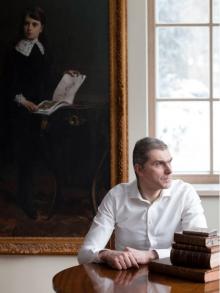
Business lawyer and collector of old and rare books Jaunius Gumbis has amassed an impressive and probably the only collection of Lithuanian publications of this scope in Lithuania. However, he himself tries to remain invisible.
"I am infinitely small, even compared to the smallest book in my collection. I am just a moment in the life of a book. That's why I don't like to talk about myself; I want the focus to be on the books, not the person who collected them. I want to remain small, because books are bigger than me," says collector J. Gumbis, sincerely expressing his fundamental view. He claims that true patrons and collectors of art rarely take photos with their unique exhibits because they do not want to overshadow them and try to remain in the background themselves.
J. Gumbis collects old Lithuanian books and books related to Lithuania, published from the early press period until 1904. These are works by famous Lithuanian authors, prepared and printed in Lithuania or other European cities, as well as works by foreign authors that contain historical data about Lithuania. Most of the collection consists of unique copies. Jaunius was motivated to compile the collection by his desire to preserve and present valuable historical sources to Lithuanian historians – books that cannot be found in Lithuanian museums and libraries.
The lawyer-collector's collection of old and rare Lithuanian books, assembled with respect, pride, and sensitivity, is probably the largest and most impressive in Lithuania. It includes such rarities as the collection of sermons Postilė by the famous Lithuanian writer Jonas Bretkūnas, Hartmann Schedel's Book of Chronicles, published in German in 1496 and considered one of the first printed sources on Lithuanian history, editions of Kazimieras Semenavičius' Didysis artilerijos menas (The Great Art of Artillery) in four languages, the collection of poems Keturios lyrikos knygos (Four Books of Lyrics) by the Baroque poet Motiejus Kazimieras Sarbievijus, and many others. "We have truly great Lithuanians who created the art of war, built forts, wrote world-class poems and legal works," says J. Gumbis. The collection is very diverse in terms of subject matter and language: it includes commemorative publications, theological, religious, scientific, and literary works, collections of legal documents, books on military topics, historical events, and travelogues in Latin, Lithuanian, Polish, English, French, Russian, Spanish, and other languages.
To mark the centenary of the Lithuanian state in 2018, the collector organized an exhibition of such books at the National Museum of Lithuania "The Collection of Lawyer Jaunius Gumbis: The Past Preserved in Books" and published a catalog of the same name—an impressive 600-page album introducing J. Gumbis' collection of old books. These books are works of art on religious and secular themes, which, according to the collector, allow us to symbolically, specifically, and intellectually rediscover the history of Lithuania. "Old books are unique, both in appearance and content, touching on almost all areas of life. In them, one can find not only historical, religious, and legal Lithuania, but also geographical Lithuania," says J. Gumbis. Such unique exhibits, according to the interviewee, are a source of pride for the country, and people should be aware of the existence of these publications and experience the charm of the past conveyed by old books.
"A book is a work of art that needs to be opened. After all, a book only gains value through the reader's gaze, which helps to understand and interpret it," says J. Gumbis. Old books have surprised him many times, so every encounter with them is exciting. "When leafing through old books, you can find all sorts of surprises," for example, In the last English edition of K. Semenavičius' Didžiojo artilerijos meno (The Great Art of Artillery), seven pages were somehow left untranslated. The person who owned it translated those pages by hand, in the handwriting of the time, rewrote them, and bound them with the rest. Or, in a scanned, unbound collection of Latin-language resolutions of the Synod of the Diocese of Samogitia, published in 1690, which was impossible to find in any library in the world, J. Gumbis discovered five pages... in Lithuanian. "Or you find a book published in 1648 with a letter to the next owner of the book attached," says J. Gumbis, recounting his surprises. It is impossible not to be amazed when you see the stamp of the Vilnius Public Library in books that have travelled from another continent. And when he saw the Sapiega Library's bookplate, the collector couldn't believe his eyes. "It's like reading a good detective story," he jokes. "Every book is a little mystery."
The collector is convinced that every book is unique in terms of the information it contains about its era and the guardian and disseminator of the national mentality. "The reality reflected in books creates a genuine, unimaginable, factual basis for pride in one's country. Books are a solid pedestal for the memory of a nation. Time is like their ally – it refines the events of centuries and the faces of eras that have been recorded, and highlights the literary role in history," writes J. Gumbis in his book Kolekcininko žodis (The Collector's Word), in which every book in his collection is an object of historical heritage.
J. Gumbis calls himself a guardian of books. Most collectors of old, extremely rare works pass them from hand to hand. "Sometimes it seems that thousands of book collections were scattered, seemingly only so that someone could collect them again. Being the guardian of such books is a meaningful and very responsible feeling and duty. And returning at least some of them is one of my main moral goals," says the collector, who has returned hundreds of valuable works to Lithuania. However, he does not overestimate his role and does not call himself a bibliophile. "There are not many people with a genuine, unpretentious passion for collecting books. In Lithuania, I was most influenced by three true book lovers and bibliophiles: Kazys Varnelis, Prof. Domas Kaunas, and the President of the Republic of Lithuania, Gitanas Nausėda. These people were a real example to me when I started collecting old books two decades ago," says Dr. J. Gumbis. We would also classify Dr. J. Gumbis as a book lover who cares about the fate of Lithuanian books. He says he never expected to be able to assemble such a collection. "Searching for rare books is a great challenge, one that I am always ready to take on," says the collector, who has amassed several hundred extremely rare books. Events such as the acquisition of complete sets of Aušra only reinforce J. Gumbis's national duty to collect as many of Lithuania's most valuable books as possible.
During wars and occupations, old and rare books were looted, so the collector acquired most of his collection (according to J. Gumbis, about 90%) abroad – in Sweden, Denmark, the Netherlands, Germany, Italy, Spain, England, Canada, the USA, etc. "Collecting books has helped me get to know collectors, antique dealers, and auction houses from all over the world," says the lawyer, talking about the secondary benefits of his hobby of collecting rare books. I have met sixth-generation collectors. According to Jaunius, communicating with them is a special privilege and an interesting part of the book acquisition process. "I can tell you in detail about every book in my collection: when and from whom I bought it, what we talked about and discussed with the seller, how the book traveled, and so on. It's all in my head." According to him, a true collector will never sell a valuable book to just anyone—they will try to get to know the buyer and make sure that the book will be cared for responsibly. "The former owner of the Bretkūnas Bible only decided to admit that he had this rare book, which is so invaluable to the history of our nation, during our seventh meeting. I will never forget how he crossed himself and kissed it before handing it over and saying goodbye," recalls J. Gumbis, once again confirming how special not only the book itself is, but also the moment of encountering it.
A true book collector and lover of books, he believes that one day he will have to donate his collection to the state – otherwise, he cannot call himself a true collector. Thinking about the fate of his collection, J. Gumbis says he knows one thing for sure – he does not want to burden his daughter Gabriele Angela with this enormous responsibility and would like the collection to remain intact. Such old and rare books must be properly stored and preserved: a certain temperature must be maintained, the rooms where the books are stored must be properly air-conditioned, and security measures must be taken – shatterproof glass, cameras, a facial recognition system, and 1.1. "It's a huge burden and responsibility that takes me away from my family, home, children, and travels, forcing me to prioritize my goals and sacrifice everything else for the book," he says. "That's why I see only one solution – to find a library that has the right conditions to take care of such a collection and understands its value," says J. Gumbis, reflecting on the future of the collection.
And how does he see the future of books? Does he feel lonely in the technology-driven 21st century, when the younger generation is glued to their screens, as he collects old, extremely valuable and rare books? What is his relationship with non-collectible books? "I am very selective when it comes to books, I don't have many," he says. "For me, quantity never translates into quality. As Leo Tolstoy said, 'It is always better to have a little that is good than a lot that is bad'. The same goes for books. I don't understand home libraries where it's unclear whether they contain books that have been read or those that are yet to be read." When choosing books to read, J. Gumbis often follows the principle that if a book is not worth reading twice, it was not worth reading the first time either. Among the authors he has read several times, he mentions Fyodor Dostoyevsky, whom he likes very much. He is not concerned about the fate of books: "Books are the only justifiable material in these times of excessive consumption. Reading a book is an incomparable pleasure – planning your time, opening the book, feeling the rustle of the pages and experiencing the emotion of being in the book for a moment. After all, reading is also a process of thinking and reasoning. No technology can replace that." Of course, according to J. Gumbis, books are changing, and we cannot escape e-books: consumerism and culture are changing books—they are becoming shorter, and their formats are changing. Therefore, he sees nothing wrong with reading academic books on a screen (and he himself uploads the teaching literature for his law students to the internet so that it is accessible at any time). "We live in a vast ocean of information, where ecology, including that of thought, is very important—to select what you really need. It is only worth having books that are truly important and help you to know yourself," the collector is convinced. Therefore, there will no longer be a need to accumulate huge libraries of unread books. In his opinion, love for books must come from within. "It cannot be imposed, so we can only hope that the views of the younger generation and our generation will converge somewhere. I strongly believe this and think that the younger generation will surprise us. We just have to let them go their own way, without trying to prove anything," concludes collector J. Gumbis hopefully.
Finally, an interesting coincidence: Lithuanian bibliophilia history features several lawyers, such as Tadas Vrublevskis, Mykolas and Viktoras Cimkauskas, Jonas Prekeris, Jonas Jurgis Gocentas, and others. Other lawyers distinguished themselves as active supporters of book smugglers, and four representatives of this guild signed the Act of Independence of Lithuania on February 16, 1918. J. Gumbis, Doctor of Law, is delighted to be able to continue this tradition.