


_220.jpg)


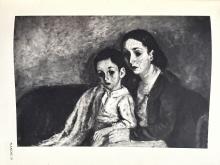
Wife and son
Created: 1930.
Material / technique: oil on canvas.
Dimensions: 81 x 116 cm.
Signature: Max Band (top-right side).
Printed: Paul Fierens. Max Band. Éd. Quatre Chemins.– Paris, 1935, No. XVIII.
According to art historian Vilma Gradinskaitė, "the family is one of the most important institutions of the Jewish community, and the wife and mother are the main guardians of Jewish traditions within the family." The phrase "Yiddish mother," born in the Litvak tradition, symbolizes the boundless care and love of a mother, celebrated in Yiddish songs and depicted hundreds of times in artists' works. Max Band (1900–1974) became an orphan at an early age, so later he focused both his personal life and creativity around the family – his wife and son became the main models in his portraits, characters in everyday and biblical scenes; the beautiful black-eyed wife is also depicted in "Portrait of a Woman" (Vilma Gradinskaitė. "Branches of Litvak Art," Vilnius: Ellex Valiunas, 2023, p. 110). The painter deliberately limited the color palette and moods, so the intrigue of his works lies in simplicity. Bando's portraits are a melancholic, elegant, and restrained version of French expressionism. Interestingly, in 1933, while visiting the USA, Bandas painted a portrait of President Franklin D. Roosevelt.
Reference: Art album "Wanderers of Fate," compiler and lyricist Vilma Gradinskaitė, Vilnius: Ellex Valiunas, 2026.
Published: Art album "Wanderers of Fate", compiler and lyricist Vilma Gradinskaitė, Vilnius: Ellex Valiunas, 2026; Art album "Wanderers of Fate" catalogue, compiler and lyricist Vilma Gradinskaitė, Vilnius: Ellex Valiunas, 2026.